
Beginner’s List of Double Die Coins to Look For
Identifying Double Die error coins requires an understanding of specific visual markers and knowledge of dates characterized by the mass production of defective dies.
This list of double die coins focuses on specimens available for discovery in modern circulation possessing confirmed numismatic value.
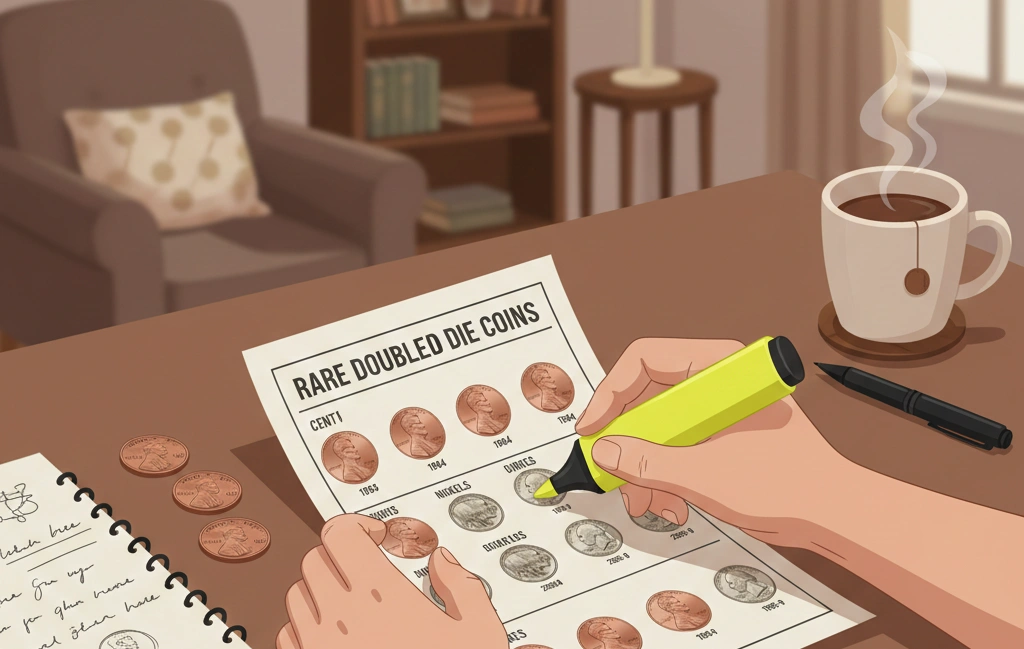
1972 Lincoln Memorial Cent (DDO Die 1)
The 1972 issue contains one of the most significant obverse errors arising from the use of a severely misaligned die.
At least nine different doubling varieties exist for this year, yet "Die 1" remains the most expensive.
Markers: Sharp and strong doubling of all letters in the LIBERTY and IN GOD WE TRUST inscriptions, as well as the date digits.
Record Price: 14,400 USD (MS67 RD condition).
Market Value (AU50): 300 - 500 USD.
Price Dynamics: Over the last 10 years, the value of high-grade specimens has increased by 45%.
1983 Lincoln Memorial Cent (DDR)
This coin represents an example of a Double Die Reverse (DDR), where the doubling is localized on the back of the coin.
This is one of the few cases where the defect appears on the denomination inscription, making it easily distinguishable without special equipment.
Markers: Strong doubling of the words ONE CENT and UNITED STATES OF AMERICA.
Record Price: 7,050 USD.
Value in Mid-Grade (MS63): 250 - 350 USD.
Statistics: The annual price increase averages about 5% with a stable volume of auction offers.
1984 Lincoln Memorial Cent (Doubled Ear)
The 1984 error is classified as a Double Die Obverse but affects only a specific element of Abraham Lincoln's portrait.
The doubling manifests exclusively in the earlobe area, creating the visual effect of a second ear located beneath the primary one.
Markers: A clear raised duplicating detail below the president's ear.
Record Price: 3,910 USD (MS68 RD condition).
Circulated Value (VF/XF): 25 - 50 USD.
Rarity Percentage: Relatively high frequency allows for finding this specimen in regular bank bags of 1980s cents.
1995 Lincoln Memorial Cent (DDO)
The 1995 issue is the most accessible Double Die example for beginning researchers.
The defect arose during a mass production period leading to hundreds of thousands of defective coins entering circulation.
Markers: Doubling of the word LIBERTY, most pronounced on the letters B, E, and R.
Record Price: 5,000 USD (a single specimen in MS69 RD).
Market Price (MS65): 20 - 45 USD.
Liquidity: The coin possesses extremely high liquidity, selling on online platforms within 24 - 48 hours.
2006 Lincoln Shield Cent (DDO)
Despite the mint's transition to single-squeeze die technology, a series of coins with pronounced doubling was recorded in 2006.
The error primarily affects the IN GOD WE TRUST inscription and the date digits.
Markers: Distortion and thickening of the font creating a "bloated" letter effect.
Record Price: 1,500 USD.
Average Price: 50 - 150 USD for specimens in Mint State.
Investment Potential: Value growth is driven by the gradual withdrawal of these coins from circulation by banks.
Year of Issue | Error Type | Difficulty (1-10) | Search Location |
1972 | DDO (Obverse) | 4 | Collections / Rolls |
1983 | DDR (Reverse) | 3 | Regular Circulation |
1984 | DDO (Ear) | 6 | Thematic Sets |
1995 | DDO (Obverse) | 2 | Bank Bags |
2006 | DDO (Obverse) | 7 | Pocket Change |
Rules for Authentication Without a Microscope
Primary inspection is conducted using a coin appraisal app.
Light falling at an angle helps reveal shadows in the areas of separation between letter contours.
A true Double Die maintains the same height for both parts of the image, excluding flat areas.
The presence of rounded edges on both doubling elements confirms the die-based nature of the error.
Step-by-Step Inspection Instructions
Orienting the coin strictly horizontally relative to the light source.
Studying the LIBERTY inscription for the presence of serifs at the ends of the letters.
Comparing the date with reference images from numismatic catalogs (e.g., Cherrypickers' Guide).
Weighing the coin to exclude counterfeits made from improper alloys.
Asset Yield Statistics
The numismatic market demonstrates price stability for the Double Die category even during economic downturns.
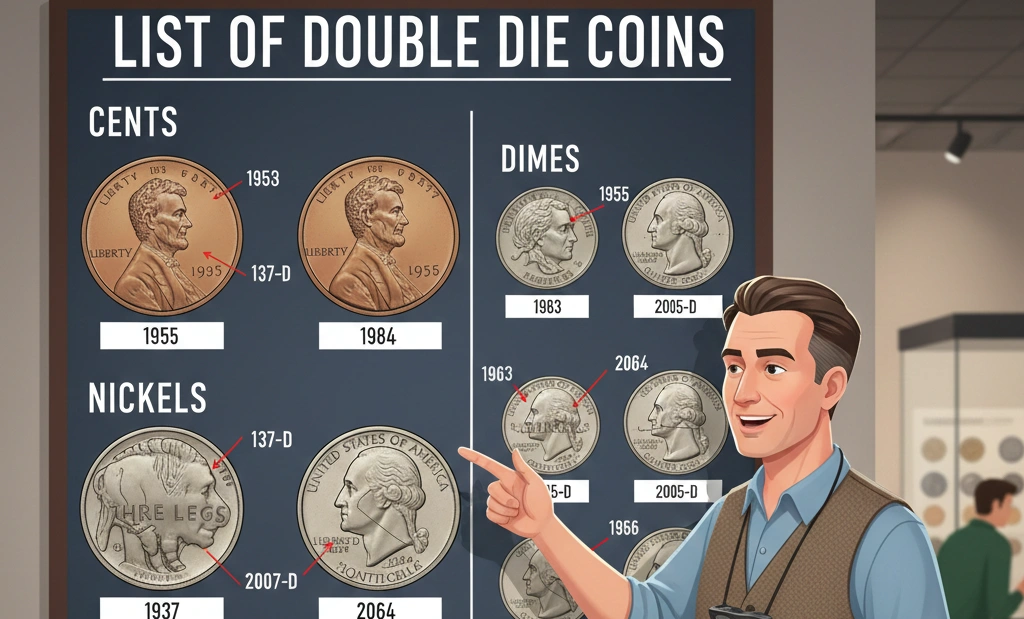
The lack of correlation with copper prices as a raw material confirms the collective nature of the value.
Annual Growth for Top Specimens (MS66+): 8.5%.
Price Depreciation for Mid-Grades: None recorded over the last 15 years.
Inflation Resistance: The real purchasing power of the investment is preserved due to limited supply.
Impact of Certification on Market Price
Obtaining grading from PCGS or NGC companies is a necessary condition for selling coins over 100 USD.
Certified coins sell 2 - 3 times faster than specimens without independent evaluation.
The cost of the grading procedure pays off when finding a coin in MS63 condition or higher.
For coins valued below 20 USD, certification is not economically feasible.
Errors Mistaken for Double Die
Beginning numismatists without the coin value app often mistake effects unrelated to die errors for Double Die.
Strike Doubling (Machine Doubling): Arising from press play, creating flat, shelf-like edges.
Die Deterioration Doubling: A result of die wear characterized by blurry outlines around letters.
Optical Illusions: The luster of a new coin can create a false impression of doubling under incorrect lighting.
The market value of such specimens equals the face value (1 cent).
Final Forecast
Searching for coins from this list remains the most effective way to enter numismatics without significant financial investment.
Statistics confirm the discovery of rare specimens even in states with high population density and fast cash turnover.
Methodical study of every coin from the 1970s - 1990s guarantees finding one of the specified varieties within the first 100 hours of searching.
Preserving coins in individual holders prevents their damage, fixing the current state of preservation.
